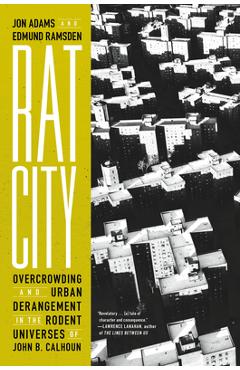
How a landmark experiment in rat behavior changed the way we think about cities. nIn the decades following WWII, the American metropolis was in peril. Modern high rises hastily erected to replace slums became incubators of criminality, while civic unrest erupted across the nation. n nEnter John B. Calhoun, an ecologist employed by the National Institute of Mental Health to study the effects of overcrowding. Calhoun decided to focus his study on rats. From 1947 to 1977, Calhoun built a series of sprawling habitats in which a rats every need was met--except space. As the enclosures became ever more crowded, resident rats began to react to social stress, culminating in the terrifying world of Universe 25: a rodent habitat where escalating social disorder collapsed to violent extinction. Did a similar fate await our own teeming cities? n nJon Adams and Edmund Ramsdens Rat City is the first book to tell the story of maverick scientist Calhoun and his now-viral experiments. Following the rats from the baiting pits of Victorian London to the laboratories of NIMH, and Calhoun from rural Tennessee to inner-city Baltimore, Rat City is an enthralling mix of dystopian science and urban history. n nSocial design, housing infrastructure, a burgeoning current of racism in city planning: Calhoun influenced them all, and Rat City connects Calhouns work to the politics of personal space, the looming threat of global overpopulation, and the eclipsing of environmental psychology by pharmaceutical psychiatry. n nAs the war on rats continues to be waged around the world, and our post-pandemic society reevaluates the necessity of urban living, the riveting story of Rat City is more relevant than ever.n