
Purdue University Press · ENSTK
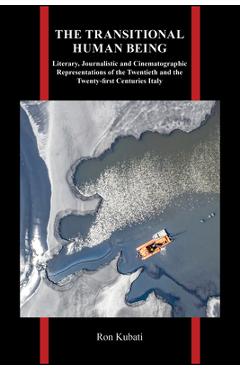
The Transitional Human Being: Literary, Journalistic, and Cinematographic Representations of the Twentieth- And the Twenty-First-Centuries Italy - Ron Kubati
EAN: 9781626711570
Compară ofertele (1)
Prețurile sunt preluate automat din feed-urile magazinelor și pot diferi față de site-ul magazinului. Verifică prețul final la magazin.
Descriere The Transitional Human Being: Literary, Journalistic, and Cinematographic Representations of the Twentieth- And the Twenty-First-Centuries Italy - Ron Kubati
\nThis book analyzes the crisis of the idea of human being based on timeless notions, in the Euroamerican context, as seen primarily through literature and cinema. It focuses on Italy, which has been and remains a crossroads for diverse cultural and political currents-open to Mediterranean cultural influences while remaining within a typically Western cultural context. The new man, defined by Corrado Alvaro during his trip in Russia in 1934 as transitional, implies a human being with a fundamental need for change. Instead of the new man, Italo Calvino in the 1960 preface to his I nostri antenati wrote about the incomplete human being who is always changing, always being completed without ever reaching completion, and thus always in transition.\n \n\n \n In these pages, the author examines the twentieth- and twenty-first-centuries Italian metamorphosis of the concept of the human being, mirroring closely at every historical turn the contextual demands of the country. From Brignone's film Sotto la croce del sud (1938), and its faulted biracial protagonists to the Netflix series Summertime (2020), characterized by the intentional lack of problematization of a multicultural society; from the fascist manhood represented by Roberto Rossellini's aviator modern knight of our time(1942), to Fellini's Marcello who chooses to not choose (1959); from Marinetti's idea of the woman who belonged to the race's development (1919) to Mazzacurati's Mara, who wishes to live thirteen different lives (2007); from Primo Levi's non-humans and stripped men, to not-belonging, to Arendt's stateless persons, to migrants crossing the desert and the Mediterranean sea in Segre's and Rosi's movies (2008, 2016): the journey chronicled in these pages is a surprising one, as today's Italy is very different than that imagined toward the second half of the nineteenth century.\n
Detalii
- Brand
- Purdue University Press
- Categorie
- ENSTK
- EAN / GTIN
- 9781626711570
- Magazine
- 1
- Disponibilitate
- in stock
Produse similare

Purdue University Press
The Fight for a Supranational World: Trieste, the Adriatic, and the Habsburgs, 1848-1867 - Mario Maritan Bonifazi
317,52 RON
libris.ro

Purdue University Press
American Agriculture: A Brief History, Rev. Ed. - Hurt Professor And Head Department Of Hi
292,54 RON
libris.ro

Purdue University Press
The Opening of Hegel's Logic: From Being to Infinity - Stephen Houlgate
292,54 RON
libris.ro

Purdue University Press
The History and Archaeology of Fort Ouiatenon: 300 Years in the Making - Misty M. Jackson
336,53 RON
libris.ro

Purdue University Press
Fine Horses and Fair-Minded Riders: Modern Vaquero Horsemanship - Julianna Ávila
336,53 RON
libris.ro
Purdue University Press
A Jesuit Garden in Beijing and Early Modern Chinese Culture - Hui Zou
339,80 RON
libris.ro

Purdue University Press
Memories of Life on the Farm: Through the Lens of Pioneer Photographer J. C. Allen - Frederick Whitford
278,95 RON
libris.ro
Purdue University Press
Laozi's Daodejing: A New Translation with Environmentalist Commentary - Steve Hallett
267,84 RON
libris.ro