
Louisiana State University Press · ENSTK
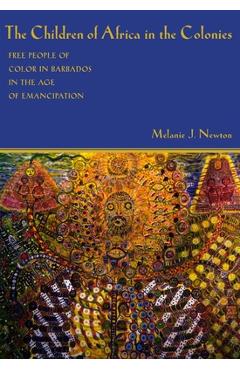
The Children of Africa in the Colonies: Free People of Color in Barbados in the Age of Emancipation - Melanie J. Newton
EAN: 9780807189177
Compară ofertele (1)
Prețurile sunt preluate automat din feed-urile magazinelor și pot diferi față de site-ul magazinului. Verifică prețul final la magazin.
Descriere The Children of Africa in the Colonies: Free People of Color in Barbados in the Age of Emancipation - Melanie J. Newton
How emancipation transformed social and political relations in Barbados When a small group of free men of color gathered in 1838 to celebrate the end of apprenticeship in Barbados, they spoke of emancipation as the moment of freedom for all colored people, not just the former slaves. The fact that many of these men had owned slaves themselves gives a hollow ring to their lofty pronouncements. Yet in The Children of Africa in the Colonies, Melanie J. Newton demonstrates that simply dismissing these men as hypocrites ignores the complexity of their relationship to slavery. Exploring the role of free blacks in Barbados from 1790 to 1860, Newton argues that the emancipation process transformed social relations between Afro-Barbadians and slaves and ex-slaves. Free people of color in Barbados genuinely wanted slavery to end, Newton explains, a desire motivated in part by the realization that emancipation offered them significant political advantages. As a result, free people's goals for the civil rights struggle that began in Barbados in the 1790s often diverged from those of the slaves, and the tensions that formed along class, education, and gender lines severely weakened the movement. While the populist masses viewed emancipation as an opportunity to form a united community among all people of color, wealthy free people viewed it as a chance to better their position relative to white Europeans. To this end, free people of color refashioned their identities in relationship to Africa. Prior to the 1820s, Newton reveals, they downplayed their African descent, emphasizing instead their legal status as free people and their position as owners of property, including slaves. As the emancipation debate in the Atlantic world reached its zenith in the 1820s and 1830s and whites grew increasingly hostile and inflexible, elite free people allied themselves with the politics of the working class and the slaves, relying for the first time on their African heritage and the association of their skin color with slavery to openly challenge white supremacy. After emancipation, free people of color again redefined themselves, now as loyal British imperial subjects, casting themselves in the role of political protectors of their ex-slave brethren in an attempt to escape social and political disenfranchisement. While some wealthy men of color gained political influence as a result of emancipation, the absence of fundamental change in the distribution of land and wealth left most
Detalii
- Brand
- Louisiana State University Press
- Categorie
- ENSTK
- EAN / GTIN
- 9780807189177
- Magazine
- 1
- Disponibilitate
- in stock
Produse similare

Louisiana State University Press
Carnival of Fury: Robert Charles and the New Orleans Race Riot of 1900 - William Ivy Hair
209,25 RON
libris.ro

Louisiana State University Press
Rituals of Resistance: African Atlantic Religion in Kongo and the Lowcountry South in the Era of Slavery - Jason R. Young
209,25 RON
libris.ro

Louisiana State University Press
The Life of Johnny Reb: The Common Soldier of the Confederacy - Bell Irvin Wiley
195,02 RON
libris.ro

Louisiana State University Press
Cold Harbor: Grant and Lee, May 26-June 3, 1864 - Gordon C. Rhea
195,02 RON
libris.ro

Louisiana State University Press
Zachary Taylor: Soldier, Planter, Statesman of the Old Southwest (Revised) - K. Jack Bauer
195,02 RON
libris.ro

Louisiana State University Press
Stalking the Ghost Bird: The Elusive Ivory-Billed Woodpecker in Louisiana - Michael K. Steinberg
186,22 RON
libris.ro

Louisiana State University Press
The Fredericksburg Campaign: Winter War on the Rappahannock - Francis Augustn O'reilly
222,92 RON
libris.ro

Louisiana State University Press
Inventions on the Brink: Essays - J. T. Barbarese
233,19 RON
libris.ro